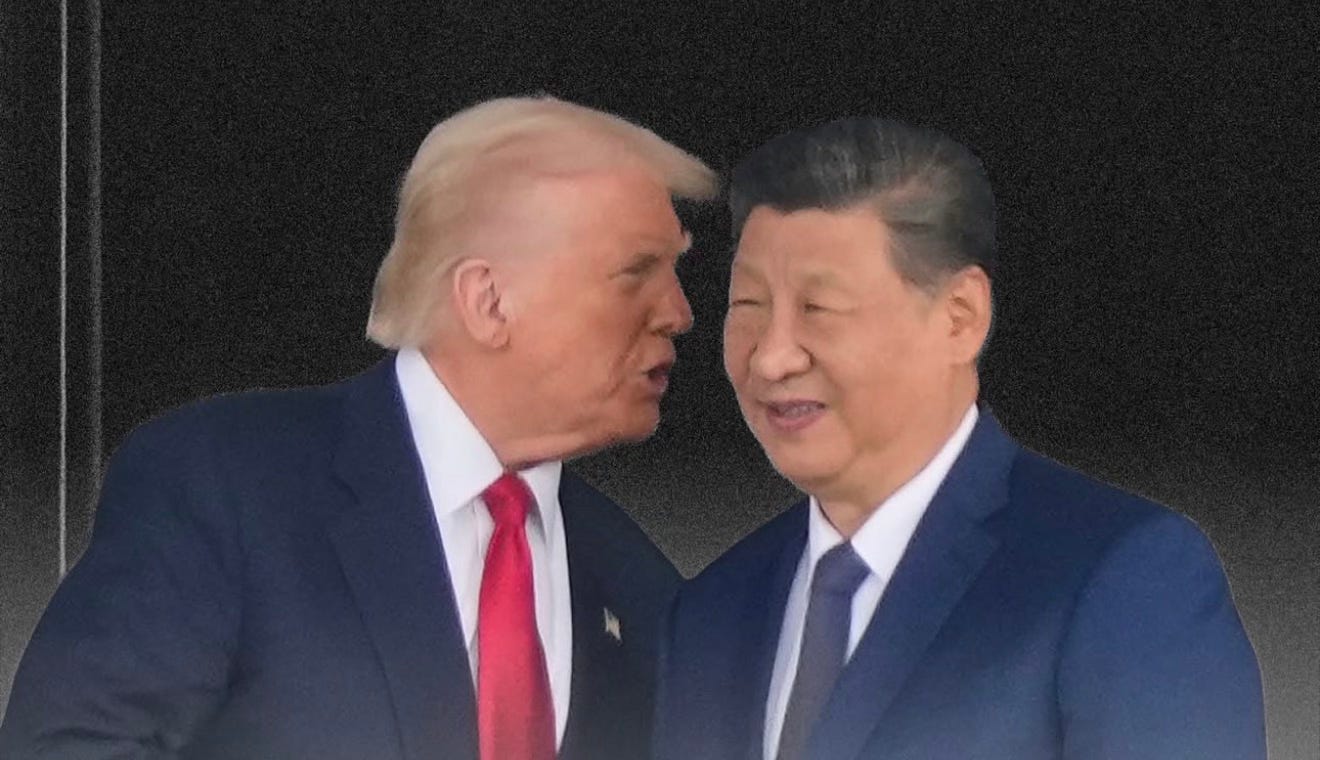
Two Predators and a Mad Dog: The New Logic of Global Order
Why Trump Desperately Needs Xi Jinping

While the world parses telephone transcripts and obsessively analyzes protocol—debating who bowed to whom, Trump to Xi or vice versa—most analysts are afraid to face the cold, hard truth. They attribute a primitive motivation to Trump: that he wants to trade Taiwan for soybeans, or simply cut a quick financial deal.
This is a dangerous naivety.
Trump is not looking for petty profit. He is building a mechanism for historical immortality and absolute power. In this scenario, current events assemble into a very different picture—ominous, yet terrifyingly logical.
1. The Myth of Weakness and the “G2” Pact
Trump is not trying to fight China, nor is he submitting as a vassal. He is seeking to divide the world. He has realized a fundamental truth: the United States cannot dismantle the existing world order (the UN, international law, the entrenched bureaucracy) alone. He needs an accomplice.
The G2 format (US + China) is not a diplomatic summit; it is a conspiracy of two super-predators. Trump is effectively offering Xi a deal: We will dismantle the old rules together.
The terms are simple: Xi gets absolute dominance in Asia (Taiwan becomes an internal Chinese matter, not an “existential problem” for the US). In exchange, Trump gets carte blanche to reformat the West. Europe becomes their shared feast. Trump intends to break its political subjectivity and seize what he needs (security control, strategic territory), while Xi gains open markets, technology, and a guarantee that Europe will never again lecture Beijing on democracy.
2. Russia as the “Attack Dog”
In this scheme, Russia is not an independent player, and no one intends to “peel” Moscow away from Beijing. On the contrary, an aggressive Russia is essential to both leaders.
The Kremlin serves the function of a “mad dog” for Europe. Economic pressure alone is insufficient to force Brussels and the old European elites to capitulate. They need existential terror.
Putin scares Europe with the threat of a great war. Europe, backed into a corner by fear, runs to the “protector” for cover. That is when Trump and Xi step in, offering salvation—but at an exorbitant price.
3. The Greenland Gambit: Territory in Exchange for Survival
What does Trump want from Europe? Not just lower tariffs. He needs a historical triumph that eclipses the Louisiana Purchase. He needs Greenland.
Recall 2019, when he first floated the idea of buying the island. The world laughed. But Trump never jokes about real estate.
To those who think only in terms of consumer comfort, this sounds like fantasy. But the electorate is a “collective animal” that forgives its leader everything if he delivers new lands. Acquiring Greenland (and its strategic control over the Arctic and resources) would elevate Trump to the status of a “Father of the Nation” who physically expanded the United States.
Europe, blackmailed by the Russian threat, may be forced to agree to the transfer (sale or lease with sovereignty) of Greenland in exchange for US security guarantees and Chinese restraint of Russia.
4. The Trap of Impunity and the Legitimatization of a New Regime
Why does Trump need this? Not for the money. Most fail to understand the tragedy of his position: Trump can no longer afford to simply walk away.
The deeper he sinks into using state power for enrichment and global repartition, the more impossible his return to civilian life becomes. Under the existing US legal system, his baggage ensures that leaving office leads not to a peaceful retirement, but to indictments, prison, and total confiscation.
He is burning bridges. Every success today distances him from a safe exit tomorrow. Therefore, he needs more than the faint hope of a loyal successor; he needs a cast-iron guarantee of survival.
The only way out is to break the American democratic system and legitimize authoritarianism. Annexing new territory is the perfect historical pretext. “I gave you a new, greater America, so the old laws no longer apply.” This justifies rewriting the Constitution, securing lifelong immunity, or establishing a dynastic transfer of power. For Trump, this is no longer about ambition—it is about physical survival.
Conclusion
We are not watching the chaotic moves of an “old man,” but a cynical, calculated operation of geopolitical racketeering.
The US and China are the beneficiaries of a new world without rules.
Russia is the instrument of terror.
Europe is the victim paying with its sovereignty.
Ukraine is not an obstacle to be removed, but the perfect instrument of pressure. A frozen conflict suits both Trump and Xi: it remains an eternal “open wound” on the EU’s border, a constant source of instability. As long as this threat exists, Europe remains vulnerable, terrified, and forced to run to the strong players for protection, agreeing to any terms.
It is time for analysts to stop laughing about “soybeans” and start fearing the real plan: the transition to a world where the rule of force finally replaces the force of law.