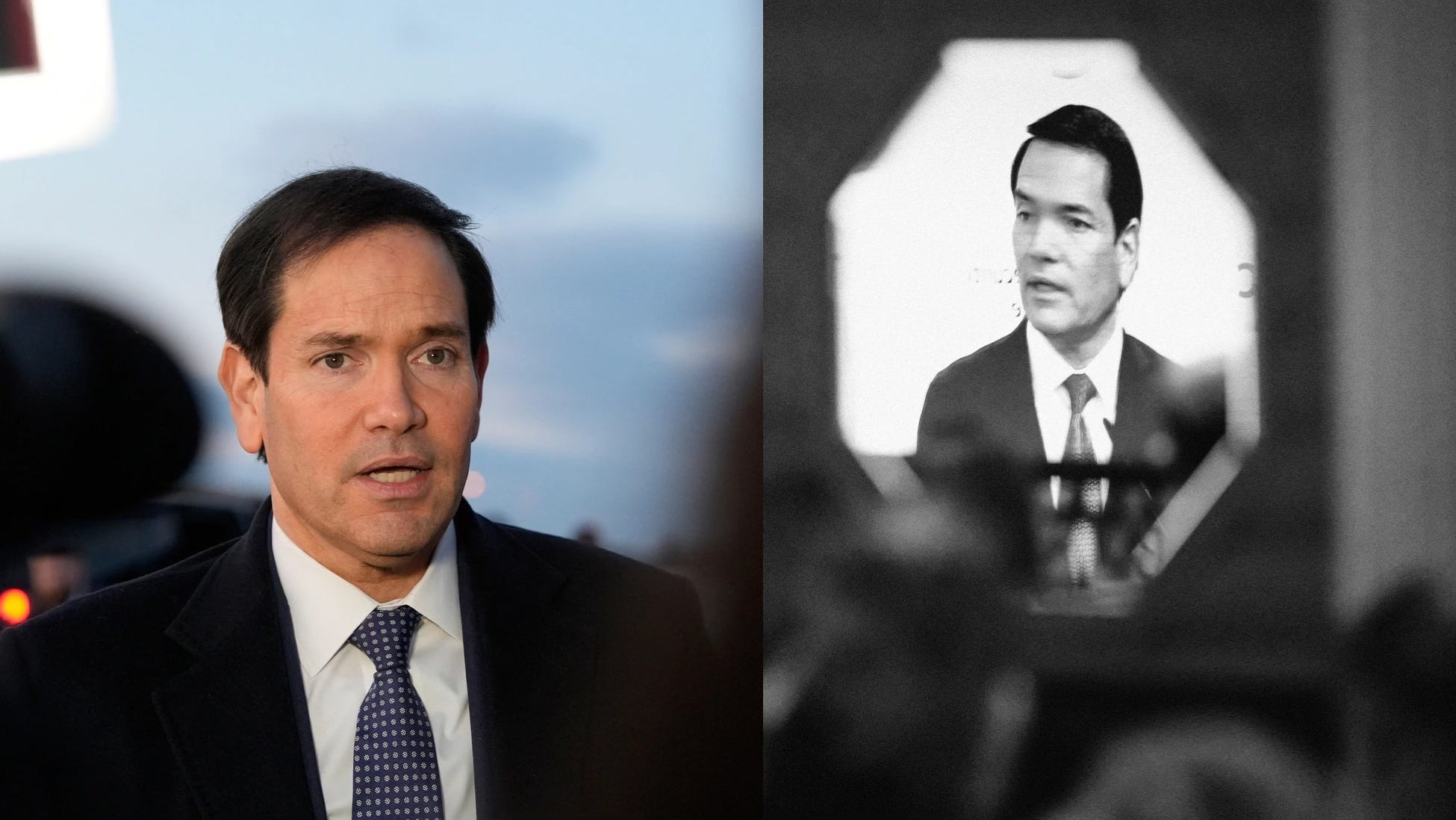
The Anesthesiologist: Why Marco Rubio’s “Civilizational” Sweet Talk is a Death Sentence for Europe

Munich, February 2026. Applause fills the hall at the Security Conference. U.S. Secretary of State Marco Rubio has just finished a speech heavy on Dante, Shakespeare, Mozart, and the Beatles. The European elite, exhausted by a year of President Trump’s aggressive protectionism, exhales in collective relief: “He is one of us. He speaks of civilization. The America we knew is still there.”
But behind the curtain of this theatrical performance, a grim reality is unfolding. While Rubio seduces Europeans with the “cultural code” of the West, Washington is coldly dismantling the infrastructure of the old world, turning former allies into a resource base.
Rubio’s speech was not an olive branch. It was a professionally calculated injection of time. His goal is to buy the U.S. precious months and years while Europe remains in a state of passive anticipation for “better times.”
The “Useful Idiots” and the Burden of Self-Deception
The liberal press, clinging to the wreckage of the past, calls Rubio’s speech “impressive” and spins fantasies about his potential presidency in 2028. Analysts like Eliot Cohen try to convince themselves and the world that the current U.S. course is a temporary anomaly, one that a “systemic” figure like Rubio will eventually correct.
This is not just naivety—it is a criminal disservice. American liberals, unable to accept the new reality, are acting as Trump’s useful idiots. They are selling Europe false hope. Their message—“wait, hold on, it will pass”—acts as a powerful anesthetic. It numbs the pain of realizing the catastrophe, but it paralyzes the will to resist at the exact moment when action is critical.
Rubio is not an alternative to Trump. He is his professional anesthesiologist. His job is to wrap the selfish “America First” policy in beautiful packaging so that the patient (the EU) does not struggle while its sovereignty is amputated.
The Trap of Waiting: Why the “Good Cop” is More Dangerous
Even if we discard the theory of cynical collusion and try to believe the favorite liberal fairy tale that Marco Rubio is playing his own game, the reality becomes even more terrifying.
Can a rational adult truly believe that three years before an election, under the nose of a vindictive and authoritarian Trump, a Secretary of State is allowed to pursue an autonomous policy of love for Europe? This is political fiction.
But let’s assume the impossible: Rubio really is sending a signal: “Hang in there, don’t burn bridges, wait for me until 2029.”
Here lies the ultimate trap. “Waiting” is the worst decision Europe can make.
In the 20th century, three years of waiting was a standard political cycle.
In 2026, in the era of AI Agents and technological singularity, three years is an epoch.
Europe risks total collapse in either scenario: whether it allows itself to be lulled to sleep by tales of shared civilization, or whether it allows itself to be persuaded to wait. The finale is the same: the transformation of a geopolitical subject into an object.
The Time Factor: A Death Sentence in the AI Era
To those outside the tech world, the call to “wait out the political cycle” might seem like prudent strategy. But those who understand the nature of current progress see the abyss.
We are trapped in a clash of different time speeds.
Political time is linear (elections every 4 years).
Technological time is exponential.
What seemed like science fiction yesterday—agentic models capable of replacing entire industries—is becoming the standard today.
Here is why the strategy of waiting is fatal:
The “Compound Interest” of Lag. Artificial Intelligence is a technology that improves itself. If the U.S. and China pull ahead in 2026–2028, the gap with Europe will not be measured in years, but in decades.
Loss of the “Nervous System.” If Europe waits for the “Good Washington” to return, its critical infrastructure (banks, energy, industry) will inevitably migrate to American or Chinese software and hardware, simply because there is no domestic alternative. Once you integrate a foreign “digital brain” into your networks, sovereignty is lost forever.
Physical Impossibility of Catching Up. Building data centers and power generation for AI takes years. Competitors are building them right now, not waiting for elections. By 2029, there will be no available chips or energy capacity left for Europe.
In an environment of exponential growth, a pause equals capitulation. Anyone advising Europe to “wait” is effectively advising it to voluntarily enter a technological coma from which it will never wake up.
The Geopolitics of the “Pasture”
Those who call the current policy “transactional” are thinking in primitives. This is not trade. This is the liquidation of the old “West” corporation and the construction of a new world order.
In this new order, Europe is assigned the role of a “pasture.”
The U.S. views the EU as a donor of capital (money flowing to Wall Street) and a captive market for its technology.
China views the EU as a technologically dependent export market.
It benefits both giants for Europe to remain in “limbo”—hesitating, holding endless summits, and believing in “transatlantic unity.” The longer Europe listens to Rubio, the deeper it sinks into dependency.
The only ones trying to disrupt this script are pragmatists like Friedrich Merz, who is attempting to build “Fortress Europe” through militarization and protectionism. But his attempts to stop time may already be too late.
Conclusion
The greatest threat to Europe today is not Russian tanks or Chinese EVs. It is the hope that things can go back to the way they were. This hope is poison.
If Europe believes Rubio’s “sweet voice” and the liberal fairy tales about 2028, it will wake up not as an ally, but as a trophy. A pasture partitioned between the true architects of the new world.