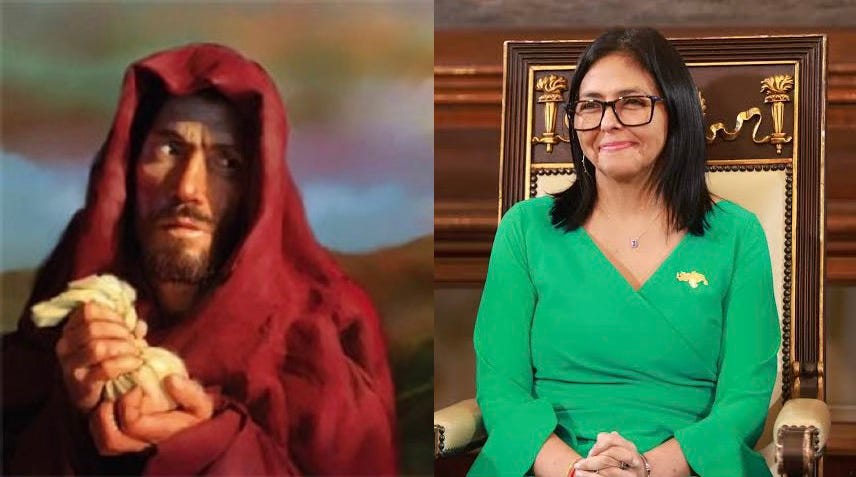
Operation Judas: 30 Pieces of Silver for Maduro's Generals

While official Washington spins a myth of “technological magic” and the flawless execution of its elite units, the real story behind the capture of Nicolás Maduro on January 3, 2026, looks less like a military thriller and more like a financial transaction. For a leader who built a multi-layered fortress of protection, the fatal blow didn’t come from a U.S. stealth helicopter--it came from the total collapse of loyalty among those he trusted most.
Below are the four key versions of the “Betrayal and Sale,” each driven by the cold self-interest of the players involved.
Version I: The “Cartel of the Suns” and Washington’s Indulgence
The most likely scenario of internal betrayal involves the top brass of the Venezuelan military (FANB).
The Essence: Generals deeply embedded in corruption and narco-trafficking (the so-called “Cartel of the Suns”) were tempted by a simple offer: Maduro’s head in exchange for immunity and the preservation of their financial pipelines.
The Arguments: According to The Wall Street Journal, U.S. State Department officials held a series of “off-the-books” meetings with high-ranking FANB leadership in Mexico weeks before the operation. The rumored deal? A guarantee that Miraflores Palace guards would stand down in exchange for unfreezing their private offshore accounts and a seat at the table in the transition government.
The Source: Both the WSJ and The New York Times have pointed to the “uncanny passivity” of the presidential guard on the night of the snatch.
Version II: Cuba’s “Key to the Bedroom”
If the generals controlled the army, the Cuban intelligence services (G2) controlled Maduro’s pulse. Without Havana’s sign-off, the Americans wouldn’t have gotten anywhere near the bunker.
The Essence: Facing a total systemic collapse of its own economy and energy grid, Havana simply could no longer afford to bankroll the Venezuelan project. Cuba sold Maduro to save its own skin.
The Arguments: As reported by Sky News’ Latin American bureau, elite Cuban units (the “Black Wasps”), who usually provided the innermost security ring, received a “stand-down” order under the guise of a training exercise just hours before the raid.
Why it matters: This was betrayal at the level of physical access. Washington likely traded sanctions relief and oil shipments to Havana for an “open door” in Caracas.
Version III: Russia’s “Switched-Off Radar”
Russia’s role was strategic: they owned the sky. Their S-300VM and Buk-M2 systems should have turned any approaching U.S. aircraft into scrap metal long before they reached the capital.
The Essence: Russia didn’t guard Maduro personally, but they provided the anti-air “umbrella.” The fact that these systems remained silent points to either a direct “kill switch” command from Moscow or the hand-over of signal codes to the Americans.
The Arguments: Military analysts at Janes Defense note that blinding a network as dense as Venezuela’s via electronic warfare alone--without internal sabotage--is technically near-impossible.
The Geopolitical Trade: Moscow likely used Maduro as a bargaining chip in a much larger game, potentially involving concessions on the European front or the lifting of specific banking sanctions. This was betrayal via strategic abandonment.
Version IV: The “Cabinet Coup” (The Rodríguez Clan)
The civilian wing of the government, led by Vice President Delcy Rodríguez, may have orchestrated a “self-cleansing” of the regime.
The Essence: Maduro had become a toxic asset, an obstacle preventing the Venezuelan elite from rejoining the global financial system. Facilitating his capture allowed certain “Chavistas” to stay “clean” while shedding a pariah leader.
The Logic: This doesn’t require secret intelligence; it’s pure Machiavellianism. When the ship is taking on water, the elite toss the captain overboard to strike a deal with the fleet that’s chasing them.
Why the “Betrayal” Narrative is a Nightmare for Washington
Despite the success of the mission, Washington is desperate to suppress the idea that they simply bought Maduro's inner circle. Here is why:
Shuttering the Myth of Omnipotence: If Beijing and Moscow realize Maduro was taken by a checkbook rather than a stealth drone, their fear of U.S. military “magic” evaporates. They won’t buy better radars; they’ll just launch more internal purges.
The Buyer’s Dilemma: Admitting you bought the betrayal of Cuban or Russian operatives confirms you are playing a “dirty game.” It incinerates the moral high ground of “fighting for freedom” and replaces it with “buying the competition.”
The Domino Effect: If it’s known that the U.S. buys generals, no dictator on earth will ever trust their staff again. This leads to waves of preemptive repression that could ultimately damage American interests.
Summary
The world was shown a cinematic masterpiece of "special operations." But behind the curtain, we find months of haggling where every key player--from the Cuban guard to the Russian radar operator--received their "30 pieces of silver." Maduro didn't lose a war. He was put up for auction, and the United States was the only bidder with enough cash to win.
Sources Cited:
The Wall Street Journal (On the Mexico/Oman secret channels)
Janes Defense Weekly (Technical analysis of S-300/Buk system silence)
Sky News / The New York Times (Intelligence leaks regarding the stand-down of security forces)