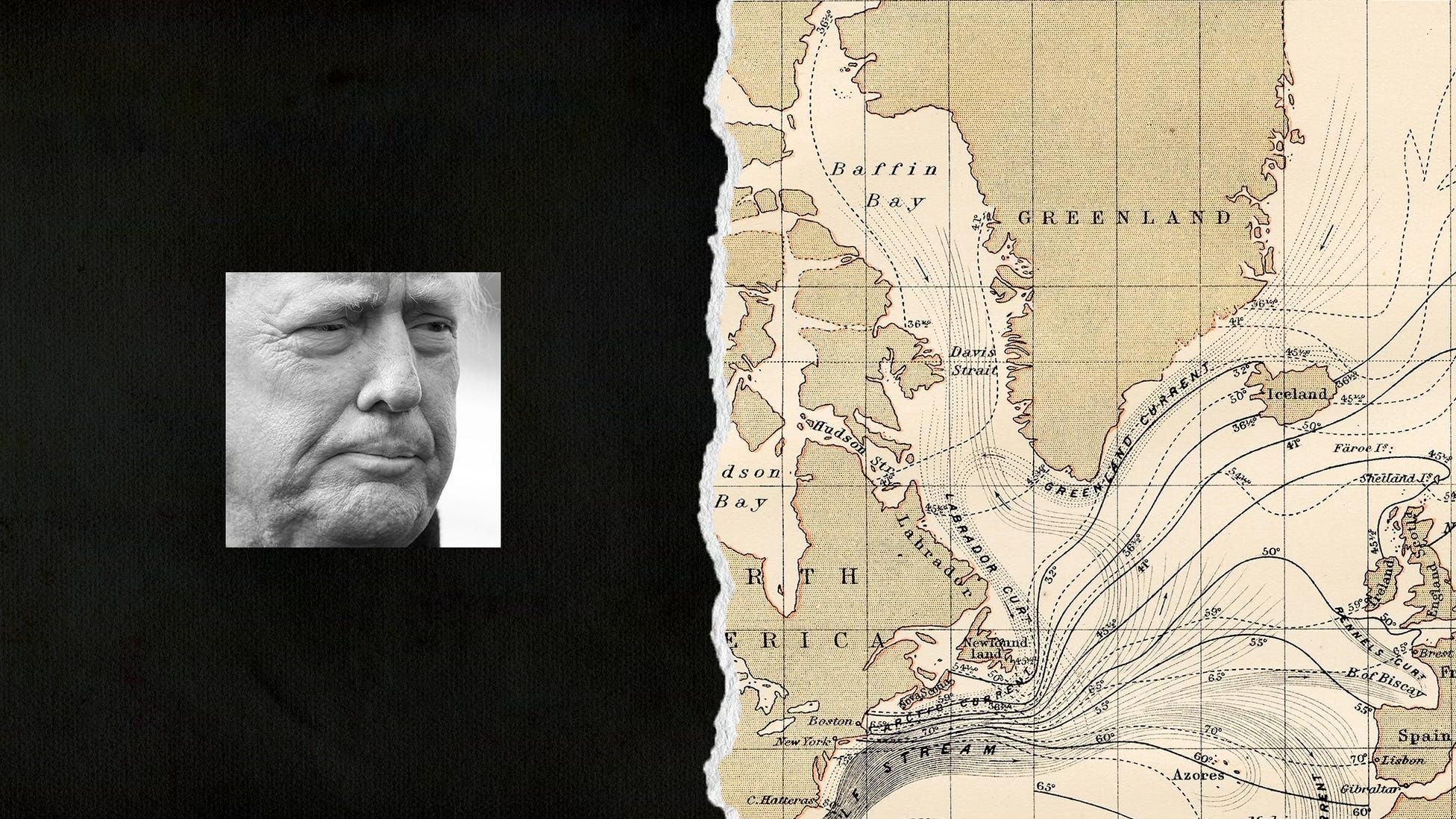
Herbivore Blindness: Why Analysts Fail to Grasp Predator Logic
A response to Eliot Cohen’s "How to Understand Trump’s Obsession with Greenland" (The Atlantic)

As the world fractures and borders are redrawn in real-time, leading liberal publications continue to engage in their favorite pastime: self-soothing. Eliot Cohen’s recent piece in The Atlantic isn’t analysis. It is a clinical symptom of a crisis in Western thought—a desperate attempt to swap brutal reality for a comfortable illusion.
Cohen and his colleagues are trying to rationalize chaos using a toolkit from the last century. They look for logic in the actions of a force that operates on raw brutality, effectively proposing to treat gangrene with a band-aid. Hidden behind labels like “ignorance,” “impulsivity,” and “playing checkers” lies the author’s inability to comprehend an entirely different operating system.
Here are the fundamental errors in Cohen’s piece that prove liberals have finally lost touch with reality.
1. The Hypocrisy of “Outsourced Heroism”
Cohen chides the Europeans for their weakness. He argues that if Denmark or other EU nations had deployed 5,000 soldiers to Greenland with orders to “fight to the last round” against American Marines, Trump would have backed down, fearing “body bags.”
This claim is breathtaking not only in its detachment from reality but in its cynicism. It isn’t just a misunderstanding of the EU; it’s a misunderstanding of human nature. But the worst part is the glaring hypocrisy.
Here we have an American liberal intellectual suggesting that Europeans should engage in a fight to the death against the United States to defend the world order. But a simple question arises: Where was this call for heroism when Trump was dismantling American institutions from the inside?
Why didn’t Cohen demand that Democrats, judges, and generals in Washington “stand and fight to the death”? Why was there no radical resistance when the Constitution was being turned into a doormat?
It is easy to demand that tiny Denmark spill blood in a war against a superpower when you failed to defend your own democracy at home. This is nothing more than projecting one’s own cowardice onto allies.
2. Misunderstanding the “Logic of Power”
Cohen writes: “The Trumpian worldview is comprehensible... erratic though the president may sound.” He tries to find a rational kernel but fails, ultimately reducing everything to primitivism.
The reality is different. Trump is not acting chaotically. He is operating under the Laws of Direct Force.
For a liberal, force is the last resort when diplomacy fails. For Trump, force is the first and only argument, while diplomacy is a sign of weakness or deception.
When Trump threatens Greenland or NATO, it isn’t hysteria, and it isn’t tyranny for tyranny’s sake. It is a cold, calculated demonstration of dominance. It is a language perfectly understood in the criminal underworld or the jungle: “I am taking this because I can.”
Cohen cannot see the logic here because he is incapable of thinking like an aggressor. He measures the actions of a predator with the morality of a victim—an “herbivore.” Trump is building a hierarchy where rights are determined by the impact of a punch, not a signature on a convention. It is a perfectly coherent, cruel system.
3. The Myth of “Playing Checkers” (The Concept Swap)
Cohen asserts: “For Trump, foreign policy is a game of checkers... played one move at a time.”
The Reality:
This is the most dangerous illusion. Trump isn’t playing checkers. He is engaging in a Meta-game.
While Cohen condescendingly analyzes “tactical errors” on the board, Trump is reformatting the space in which the board stands.
Liberals think: “How do I win the game by the rules?”
Trump thinks: “How do I buy the casino you’re playing in and change the value of the chips?”
He destroys NATO, the UN, and international treaties not because he doesn’t understand their value (i.e., he is “stupid”), but because the old rules hinder his power. His actions regarding Greenland or the “Board of Peace” are not pawn moves; they are changes to the architecture of reality. He is not trying to win within the old system; he is building a new one where he is the owner of the establishment, not a player. To call this “checkers” is to admit one’s own incompetence.
4. The Performance of “Naivety” as Cover
Cohen claims that “Other players have learned to manipulate Trump,” citing how Putin runs circles around him or how Canada is “fleeing” to China.
The Reality:
It is pathetic to watch liberals confuse their own defeat with someone else’s clever game. They mistake complicity for naivety.
It is profitable for Trump to look like the one being manipulated.
When he “allows” Putin to act or “doesn’t notice” a threat, he isn’t the victim of deception. He is consciously playing the role of the “bumbling peacemaker” to give autocrats time and space to operate.
It is the perfect alibi: “I wanted the best, I believed him, what a horror.”
This allows him to sabotage aid to allies (Ukraine, Europe) without entering into open confrontation with his own electorate.
He is not a puppet; he is a partner providing “cover” for other predators, pretending he just “didn’t figure out the situation.” And Cohen buys a ticket to this performance and writes a review about the bad acting, failing to realize that the theater belongs to the actor.
5. The Trap of the “Understandable Motive” (The Bait)
The most dangerous part of the article is the author’s readiness to “understand” Trump’s motives through simple explanations: resources and ego. “Greenland is rich in metals, and Trump loves real estate,” the analysts nod joyfully.
They swallowed the bait. The old rule applies: “If you want to hide your real motive, give your opponent a convenient explanation he is ready to believe.”
Trump threw them the bone of “rare earth metals” so they would gnaw on it and stop looking for the real reason. The true goal isn’t resources. It is creating a precedent for Might makes Right, legitimizing annexations through pocket structures (like the “Board of Peace”), declaring states of emergency, and dismantling the electoral system.
He doesn’t need an island; he needs a crisis surrounding the island to change the rules of the game forever.
6. The Price: A Looter’s Instinct, Not a Genius’s Strategy
We should not turn Trump into an intellectual giant. His “victory” over the system is based not on complexity of thought, but on a primitive yet shocking transaction.
Trump is executing the “Great Exchange.”
He is taking the intangible assets America has accumulated over 80 years—allied trust, international law, the reputation of a stability guarantor—and swapping them for one physical asset (Greenland) and personal power.
Liberals are horrified because they value what he is throwing away (institutions). Trump is calm because, to him, those institutions are worthless.
The Louisiana Effect: He needs this island to stand alongside the “greats” (like Jefferson) and declare: “I physically made America greater.” He needs an acquisition so shocking and massive that it eclipses all the negativity and chaos.
Ticket to Eternity: Such a historic expansion of borders is the perfect foundation for a third term (or eternal rule). Under the guise of such a geopolitical shift, the Constitution becomes a secondary concern.
This is not the strategy of a genius. It is the behavior of a looter burning down the family estate (US institutions) to buy himself a golden throne. It is an immeasurable cost for the country, but an acceptable price for Trump. And it is precisely this willingness to sacrifice the nation’s future for a personal trophy that analysts cannot grasp, confusing it with “political games.”
Conclusion
Eliot Cohen and the liberal elites find themselves in the position of indigenous islanders meeting colonizers for the first time. They understand neither the strangers’ weapons nor their motives, so they explain their actions as “magic” or “stupidity.”
Trump is neither primitive nor great. He simply represents a different evolutionary species—a political predator free from moral constraints. And while analysts laugh at his “game of checkers,” he will finish finalizing the deed to the board, having already sold the building they are sitting in.