

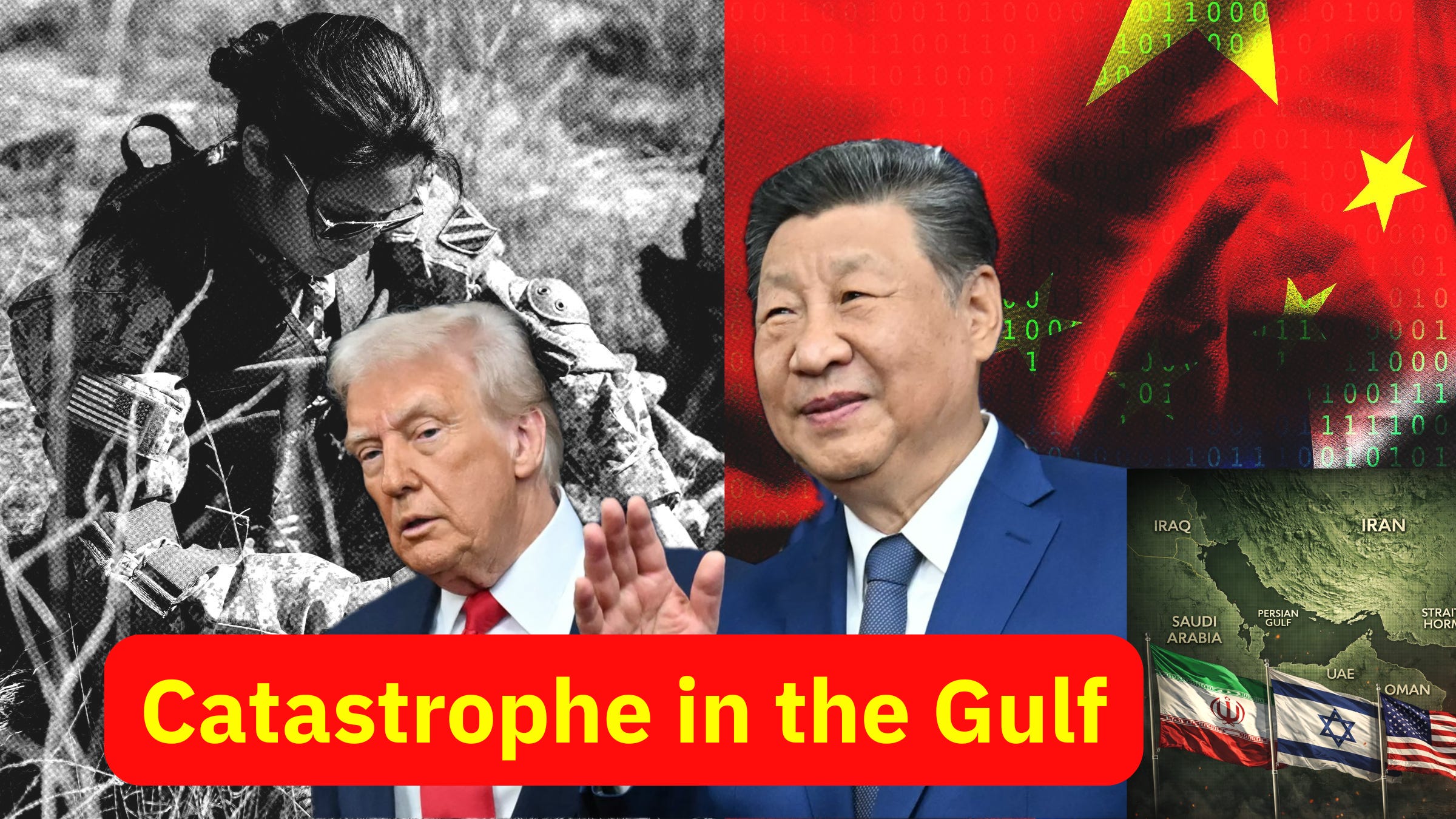
Donald Trump keeps threatening. Iran — with a new campaign. Oman — with bombing. The region at large — with resolve that knows no limits. The volume of these statements is usually explained away as a character trait or a negotiating style. That is a category error. The volume is neither trait nor style. The volume is a function. It covers one inconvenient fact and buys time for one specific operation.
The fact is about the stockpile. The operation is about Beijing.
What everyone chose to forget
In May of this year, the Center for Strategic and International Studies — not some opposition outlet, but a Washington think tank writing for a Washington audience — published an analysis of how long it would take to rebuild American missile inventories after the 39-day campaign against Iran. The document was never refuted. Something worse was done to it: it was forgotten. Outside a narrow circle of experts, hardly anyone mentions it. Least of all the people issuing the threats.
And here is what the document — built on the Pentagon’s own budget materials — records. More than a thousand Tomahawks expended in a single campaign; prewar inventory restored by late 2030, at best. To replace the Patriot interceptors fired off, the Army has requested 3,203 missiles; deliveries from that order begin in 2029. THAAD needs 857 interceptors replaced; done by late 2029. Between the money being appropriated and the first missiles reaching the shelf lies a production cycle of 34 to 39 months. And money doesn’t fix it — the authors themselves stress that the binding constraint today is time, not funding. The bottom line is theirs too, no critics required: a “window of vulnerability” lasting several years.
In other words: the principal instrument with which the United States can wage war at a distance at all — without putting troops on the ground — burned out in 39 days against an adversary with no first-rate air defenses. Deliveries to allies are already being cut to the bone: THAAD shipments re-sequenced in favor of America’s own stocks, four hundred Tomahawks for Japan postponed, Ukraine pushed back in the Patriot queue. As for the ground alternative to standoff warfare in the Middle East — the expert consensus since Iraq has been unanimous: catastrophic.
This is the arsenal from which threats of a new war are being issued. A war in which, until the end of the decade, there is physically nothing to shoot. That is a bluff — in the precise, card-table sense of the word: a big bet on an empty hand. And like every bluff, it does not exist for its own sake. It buys time.
Time for what?
The third addressee
Recall the procedure. Every major war of recent decades Washington launched only after first assembling a coalition — broad, as in 1991, or a stage prop, like the “coalition of the willing” in 2003. This is not ceremony. It is a mechanism: a coalition dilutes responsibility, so that defeat or quagmire ceases to have a single name and a single address. The war against Iran was launched without that mechanism. For the first time, the responsibility remained undiluted — personal.
And Washington’s behavior since then reads as a search for someone to share that responsibility with, after the fact. First — the attempts to pull in NATO. Then — the key capitals of the EU. Both, to their credit, refused to be used. And once the nearer addressees said no, only one remained: the power with genuine leverage over Tehran that had not yet said “no” in public.
And at precisely that moment, the flagship of American foreign-policy thought publishes a piece whose title explains everything by itself: “The Gulf’s China Problem. Beijing Wants Trade but Not Responsibility.”
The mechanism, dissected
The Foreign Affairs article (Alsudairi, Ghiselli, Glasserman, July 21) deserves examination not as analysis — there is no analysis in it — but as a specimen. It is entrapment caught in the act. The mechanics are simple: three moves.
Move one: whom the role is assigned to. The entire text is one continuous reproach of Beijing for its “irresponsibility”: China, we are told, refuses to shoulder the security burden, has no vision for a regional order, has failed to become a “stakeholder.” Which is to say: China is being insistently offered responsibility. Responsibility for what, exactly? For a region on fire as a consequence of an American decision to start a war. The decision itself the article mentions in a single line — like the weather — and brackets out. The question “should this war have been started at all” is removed by the framing itself; all that remains is “who answers for it now.”
Move two: how the trap is dressed. Note the assortment of roles the text tries on Beijing: guarantor, mediator, security stakeholder, participant in a settlement. Not one of them involves Chinese missiles or Chinese soldiers — and that is the whole point. Washington does not need China’s military participation. It needs Beijing to enter the situation as a party — in any capacity, even just a seat at the talks. Because the moment that happens, every outcome acquires a co-author. Talks collapse — “we couldn’t do it together.” Escalation — “Beijing failed to restrain Iran.” Any ending stops being purely American. A signature is the only thing being purchased here. Not a resource. A name on the consequences.
Move three: how refusal is punished. Since Beijing declines the role, its refusal has to be renamed. And the text renames it: the cold calculation of a player unwilling to pay for someone else’s war becomes “paralysis” and a “lack of vision.” And on top of that — an insinuation of “complicity” in Iran’s strikes, hung on the construction reports that Chinese companies may have provided targeting intelligence. Nameless “some Gulf states” believe something, on the strength of reports-that-may-have. A grave accusation resting on a support that crumbles at a touch — yet inside the text it does its work. The result is a fork: enter, and you co-sign the defeat; stay out, and you wear the label of an irresponsible power, or an accomplice. Both tines are meant to work for Washington.
Just as telling is what the text found no room for. The only articulated alternative that involves no external patron at all — Oman’s proposal for a regional order built by the monarchies themselves, together with Iran and Iraq — gets exactly one sentence. A frame built around the question “which great-power guarantor does the Gulf need” is physically incapable of digesting the answer “none.” So the answer gets one line.
The player who read the move
Now consider Beijing’s own behavior — as documented, inadvertently, by the very same article. Instead of pressuring Iran over the Houthis: a private arrangement securing Chinese-flagged ships, and Chinese-flagged ships only. Leverage over Tehran: present. Use of it: zero. Trade with the Gulf: pushing three hundred billion. Security commitments: zero. The authors sum it up reproachfully — Beijing, they note, keeps every economic benefit while carrying even less security risk than before. They believe they are delivering a diagnosis. What they are describing is a winning position.
Because this is not paralysis. This is a player who saw the fork one move ahead — and declined to step into it. Beijing is waiting for the author of the war to pay the full price of his own decision: with stockpiles that stay empty into the 2030s, with allies bumped down the delivery queue, with a posture in which the louder the threat, the more obvious the bluff. Every month of Chinese non-participation in the “settlement” is a month in which the defeat keeps a single name and a single address. Washington.
The position
Now assemble the whole picture. A state starts a war on its own, without a coalition — abandoning, for the first time, its own mechanism for diluting responsibility. In 39 days it burns through a strike arsenal it will be rebuilding into the next decade. It threatens new campaigns it has, until the end of the decade, effectively nothing to fight with — and hopes nobody will recall the arithmetic published by its own think tank. A deal with Tehran would mean humiliation with a signature and a date on it. And so, from the pages of its most venerable journal, it pleads with its geopolitical rival — its rival! — to enter the situation in some role, any role, so there will be someone to share the authorship of the ending with. And receives in reply polite commerce and exactly zero signatures.
You can call this strategic flexibility. You can call it a tactical pause. But when a superpower begs its competitor for complicity in its own defeat — wrapping the request in reproaches about “irresponsibility” — the language has a more precise word for that position.
Pitiful.
---
Sources: Mark F. Cancian and Chris H. Park, “Rebuilding U.S. Missile Inventory: A Multiyear Project,” CSIS, May 27, 2026 (calculations based on the Pentagon’s FY 2027 budget materials); M. Alsudairi, A. Ghiselli, and A. Glasserman, “The Gulf’s China Problem,” Foreign Affairs, July 21, 2026.
Sources:
Rebuilding U.S. Missile Inventory: A Multiyear Project
Published May 27, 2026
https://www.csis.org/analysis/rebuilding-us-missile-inventory-multiyear-project
Sources:
The Gulf’s China Problem
Beijing Wants Trade but Not Responsibility
Mohammed Alsudairi, Andrea Ghiselli, and Aaron Glasserman
July 21, 2026
https://www.foreignaffairs.com/china/gulfs-china-problem